Letter Tracing Practice for Kids: A Practical Template for Creators and Educators
The development of foundational skills, such as letter recognition and pencil control, is a critical early learning stage. For professionals, educators, and creators involved in producing educational materials, sourcing or designing effective practice sheets is a common task. The Letter Tracing Practice for Kids -R template represents a specific, streamlined solution within this broader workflow of creating learning resources. It is not merely a worksheet; it is a fully editable, production-ready asset designed to integrate smoothly into the content creation and publishing process.
Understanding the Asset's Role in Educational Content Creation
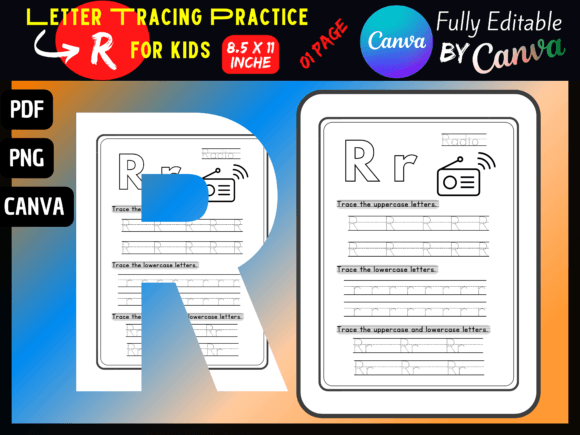
Creating educational worksheets typically involves a multi-stage process: conceptualization, design, quality assurance, formatting for distribution, and finally, publication or deployment. Each stage demands time and specific skills. The Letter Tracing Practice for Kids -R template is positioned to significantly streamline the design and formatting phases. It is a pre-built, focused worksheet centered on the uppercase and lowercase letter 'R', complete with guiding tracing paths. This specificity means a creator or educator does not start from a blank canvas. They begin with a professionally structured foundation, allowing effort to be redirected towards customization, scaling production, or integrating the sheet into a larger curriculum package.
This approach is particularly valuable for individuals managing multiple projects or lacking extensive graphic design expertise. Instead of investing hours in aligning tracing paths, setting consistent fonts, and ensuring print-ready dimensions, the user receives an asset that has already resolved these technical requirements. The workflow thus shifts from foundational construction to practical adaptation and implementation.
Integration with Tools and Platforms: The Canva and KDP Connection
The practical utility of any template is heavily dependent on its compatibility with common tools and platforms. This letter tracing template is explicitly built for seamless interaction with two key systems: Canva for editing and the Kindle Direct Publishing (KDP) platform for distribution.
Editing within the Canva Ecosystem
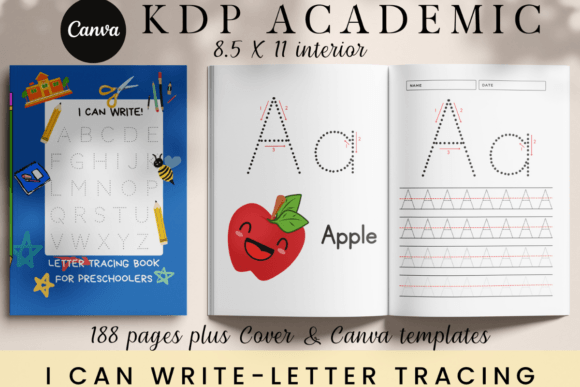
The provision of a fully editable template via a free Canva account is a significant workflow integration point. Canva operates as a central hub for many creators, educators, and small business owners for its user-friendly design interface. By receiving a direct link to the template within Canva, the user can immediately access the worksheet without file conversion or format wrestling. Within Canva, the editable nature allows for practical modifications: changing colors to suit a brand or theme, adjusting fonts if desired, adding supplementary instructions or graphics, or even duplicating the page to create a series for other letters. This flexibility means the single Letter Tracing Practice for Kids -R template can serve as the genesis for a wider set of materials, all while maintaining consistent dimensions and quality.
Production-Ready for KDP Publishing
For entrepreneurs and publishers aiming to sell educational materials, the final step often involves uploading to a print-on-demand or digital marketplace. The template’s specification of being “Ready for Upload to KDP” and tested on that platform addresses a critical late-stage workflow hurdle. The included high-quality print-ready PDF (8.5 x 11 inches, no bleed) is formatted to meet KDP’s technical requirements. This eliminates the common, time-consuming process of adjusting file dimensions, resolving bleed issues, or ensuring print clarity after the design is complete. The user’s workflow can proceed directly from final customization in Canva to the upload phase on KDP, with confidence in the file’s compatibility. The additional PNG file offers further flexibility for digital use in blogs, teaching platforms, or social media.
Practical Implementation in Diverse Workflows
The application of this specific template varies depending on the user’s role and project goals. Its design supports efficiency and consistency across different implementation scenarios.
For the Educator or Homeschooling Parent
An educator integrating letter tracing into a lesson plan can use this asset as a ready-to-print activity sheet. The workflow is straightforward: access the template via Canva, potentially add the student’s name or a date for organization, download the PDF, and print. It saves the time of searching for a suitable worksheet online or creating one manually. Furthermore, its quality ensures clear tracing lines for young learners, supporting effective pencil skill development. For a homeschooling parent managing multiple subjects, this ready-made resource reduces preparation overhead, allowing focus on instructional delivery.
For the Creator Building a Product Series
A creator developing a full alphabet tracing workbook faces a substantial design task. Using the Letter Tracing Practice for Kids -R template as a proven model establishes consistency. After customizing the 'R' sheet to their desired theme (colors, perhaps a logo), they can replicate the structure in Canva to produce sheets for letters A through Z. This templating approach ensures every page has identical dimensions, layout, and print quality, which is vital for professional product consistency. The initial time investment in adapting one template pays dividends in efficient production of the remaining 25 sheets, streamlining the entire project workflow.
For the Entrepreneur on KDP
The entrepreneur’s workflow often prioritizes speed-to-market and technical reliability. This asset, delivered as a ZIP file with the exact required formats, functions as a near-final product component. The process can be: unzip the file, review the PDF for final quality, optionally make brand adjustments in Canva using the editable link, and then upload the PDF directly to KDP. The pre-testing on KDP mentioned in the specifications reduces risk and post-upload revisions, a common efficiency drain. This allows the entrepreneur to concentrate on marketing, pricing, and listing optimization rather than file troubleshooting.
Key Factors for Long-Term Use and Quality Control
Integrating a pre-made template into one’s regular workflow requires consideration of a few practical factors to ensure sustained utility and output quality.
Preparation and Organization: Upon receiving the ZIP file, systematically storing the editable Canva link, the master PDF, and the PNG ensures they remain accessible for future use or modification. Saving the Canva template to your own Canva account is a recommended step for long-term access.
Consistency in Customization: If using the template to create a series, document your customizations (e.g., a specific color hex code, a chosen font). Applying these consistently across all derivative sheets maintains a cohesive look, which is essential for branded products or professional teaching materials.
Quality Verification: Even with a pre-tested PDF, performing a final check before any bulk printing or KDP upload is prudent. Print one test page to verify line clarity and alignment. This simple step within your workflow can prevent larger issues downstream.
Usability for the End-User: The ultimate goal is to provide a practical learning tool for children. The template’s clean tracing paths and ample practice space are designed for this. When customizing, avoid adding overly complex decorations that might distract from the core tracing activity, keeping the focus on skill development.
Streamlining the Path from Concept to Finished Resource
In summary, the Letter Tracing Practice for Kids -R printable alphabet tracing worksheet is more than a simple practice sheet. It is a workflow accelerator. It fits into the processes of creators, educators, and entrepreneurs by providing a resolved, high-quality starting point that interoperates with common design and publishing platforms. By handling the foundational design and technical formatting, it allows the user to invest effort where it matters most: in customization, scaling, curriculum integration, and distribution. For anyone regularly involved in producing educational content, such specialized, production-ready templates are not just assets; they are practical tools that optimize planning, execution, and implementation, turning a single letter practice sheet into a reliable component of a larger, efficient workflow.